
How to Spot Fake Organic Labels: 7 Checks That Work
Quick Summary
To spot fake organic labels, check the pack for an official certification logo and a licence number, then confirm that number in the certifier’s online database. A green leaf or earthy design alone is not proof of certification, and words like natural or eco-friendly are not regulated organic claims.
- A green leaf or earthy colour scheme is a design choice, not proof of certification.
- Look for an official certification logo and a licence number on the packaging.
- Match the licence number against the certifier’s own online database, not a third-party site.
- Only products labelled 100% organic contain exclusively certified organic ingredients.
- If a label cannot be verified, ask the retailer for the operator’s certificate before buying.
Table of Contents
- Why Organic Labels Are Worth Checking Before You Buy
- Step 1: Learn What the Soil Association Organic Standards Require
- Step 2: Look for a Genuine Certification Logo and Licence Number
- Step 3: Tell the Difference Between Organic and Natural Labels
- Step 4: Check Certification Online Using Official Databases
- Step 5: Recognise Greenwashing and Common Fraudulent Labelling
- Step 6: Verify Your Purchase After It Arrives
- Booking Your Next Step: Shopping Organic With Confidence at Heather & Rose
- Frequently Asked Questions
Why Organic Labels Are Worth Checking Before You Buy
Not every product with a green leaf on the front is genuinely organic, and shoppers are often caught out by fake organic labels that use vague wording and look-alike logos. This guide walks you through practical checks you can use in the shop or at home.
Organic labels matter because they tell you how a product was grown and processed. In the UK, the word “organic” on a food or supplement is protected, which means a certified product has passed inspection by an approved body.
A quick check takes less than a minute. It also saves you from paying a premium for something that does not meet the standard you expected.
Watch out: A green leaf or earthy colour scheme is a design choice, not proof of certification. Always look for the official logo and licence number instead.
Step 1: Learn What the Soil Association Organic Standards Require
The Soil Association is one of the best-known organic certifiers in the UK. Its standards set out how crops and livestock must be farmed, and how products must be processed and labelled to carry its certification mark.
Under these standards, certified products must be traceable back to the farm or supplier. They also limit the use of synthetic pesticides, fertilisers and additives. Knowing this helps you judge whether a claim on a label is plausible.
Look for these core principles when you review a product:
- Ingredients are grown without routine synthetic pesticides
- Products are checked regularly by an accredited certifier
- The supply chain can be traced from start to finish
Understanding the standard gives you a benchmark. Once you know what certification requires, it is much easier to spot fake organic labels that make promises they cannot keep.
Step 2: Look for a Genuine Certification Logo and Licence Number
A genuine certified product carries an official certification logo and a licence number. The logo is a registered mark, and the licence number identifies the specific operator the certifier has approved.
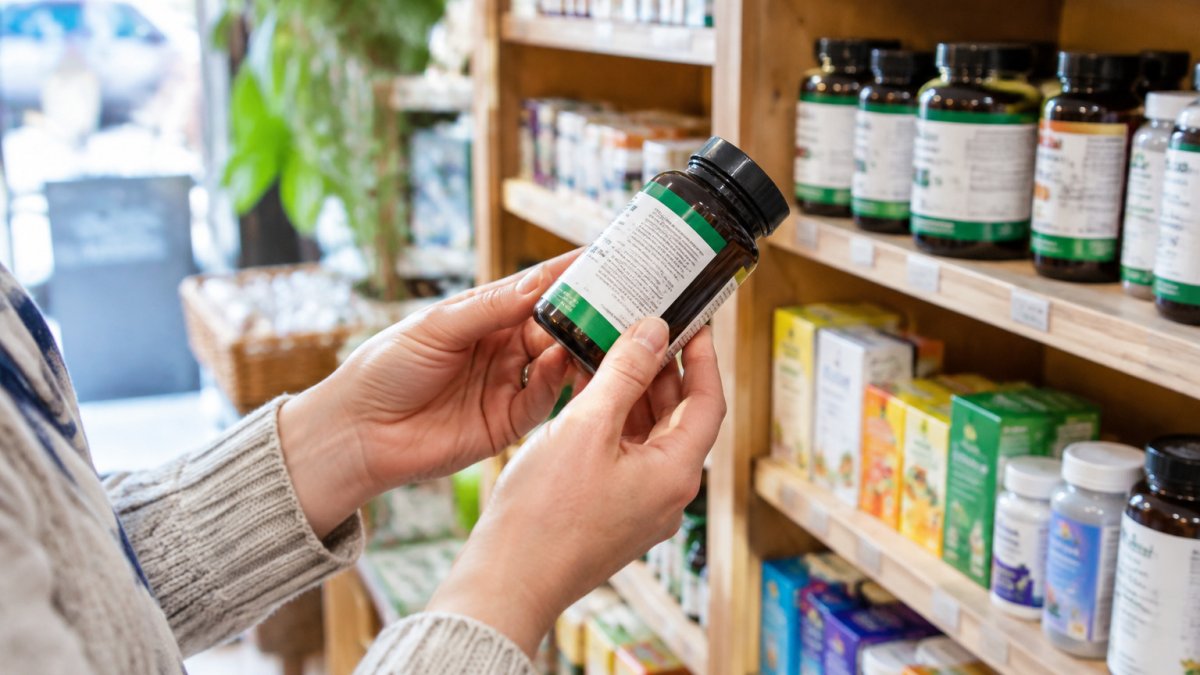
Check the packaging carefully:
- Find the logo, usually near the ingredients or front panel
- Locate the licence or certificate number, often in small print
- Confirm the logo matches the certifier’s official design
A common trick is a logo-like graphic that looks official but has no certifier behind it. If there is no licence number, treat the claim with caution.
Turn the bottle over and read the back before you put it in your basket.
Step 3: Tell the Difference Between Organic and Natural Labels
“Natural” and “organic” are not the same thing. A product can be described as natural with no independent check at all. Organic certification, by contrast, involves regular inspection and strict rules.
The difference between organic and natural labels is one of the most common sources of confusion. “Natural” is often used as a marketing word, while “organic” is a regulated term with specific standards behind it.
Keep this in mind when you read claims:
- “Natural” is usually not verified by a third party
- “Organic” should come with a certification logo and licence number
- Other terms such as “free-from” or “wholesome” are marketing language
Decoding 100% Organic versus Made with Organic Ingredients
Labels can say “100% organic” or “made with organic ingredients”, and the two mean different things. A “100% organic” product contains only certified organic ingredients. A “made with organic ingredients” product may contain as little as a portion of certified content, with the rest made from non-organic sources.
Read the wording closely. If you want the full organic standard, look specifically for “100% organic” on the label.
Spotting Misleading Marketing Terms
Some words sound reassuring but carry no certification behind them. Terms such as “eco-friendly”, “pure”, “chemical-free” or “nature-inspired” are not organic labels. A product can use them and still contain non-organic ingredients.
Ask yourself whether the claim names a certifier or licence. If it does not, it is marketing, not proof.
The article contrasts the terms shoppers see most often, so this quick comparison sets out what each label actually means.
| Label term | What it means | Check before you buy |
|---|---|---|
| Organic (certified) | Regulated term, regular third-party inspection | Logo and licence number present |
| Natural | Marketing word, usually not verified | No certifier named |
| 100% organic | Only certified organic ingredients | Read the exact wording |
| Made with organic ingredients | May contain non-organic ingredients | Not the full organic standard |
| Eco-friendly / pure / chemical-free | Reassuring phrasing with no certification | Does a certifier or licence back the claim? |
Step 4: Check Certification Online Using Official Databases
A licence number on a label is only useful if you can check it against a live register. In the UK, organic certification is delivered by control bodies approved by the Department for Environment, Food & Rural Affairs (Defra), and each approved body publishes its own searchable directory of certified operators (Organic products: approved UK control bodies).
Start by identifying which control body issued the certificate. The certifier’s name or code is usually printed next to the logo or in the small print on the back panel.
A workable sequence is:
- Photograph the back panel so you have the licence number, certifier name and product name in one image.
- Go to the certifier’s own website, type the organisation name into a search engine and follow the official domain rather than a sponsored result.
- Open its ‘certified operators’, ‘find a producer’ or ‘licence check’ page.
- Search the licence number first, then the business name if the number returns nothing.
- Confirm that the product category on the certificate matches what you are holding (for example, food and drink, cosmetics, or supplements are often certified under separate scopes).
A common pattern is that the business appears in the database but the specific product does not. Certification is granted to an operator and a scope of products, not to every item a brand sells.
For imports, the check is different. Organic goods entering the UK must be covered by a certificate of inspection issued in the country of origin and recognised under the UK’s import arrangements.
Watch out: a QR code on the pack is not proof of certification on its own, it can point to a brand’s own marketing page. Scan it, but then cross-check the licence number in the certifier’s register rather than trusting the landing page it opens.
If the number cannot be found in any approved control body’s register, treat the organic claim as unverified and ask the retailer for the certificate before you buy. A legitimate brand will normally be able to supply the operator’s certificate or a link to its entry on request.
Step 5: Recognise Greenwashing and Common Fraudulent Labelling
Greenwashing is when a brand makes a product look more organic or sustainable than it really is. It is often subtle. Images of fields, handwritten fonts and earthy colours can suggest a farm-fresh origin with no certification to support it.
Common warning signs include:
- Logos that look official but name no certifier
- Claims with no licence number or database entry
- Fine print that contradicts the front-of-pack message
Be alert to the psychology behind these designs. Packaging is built to reassure you quickly, so slow down and read the small print before you trust the picture.
Step 6: Verify Your Purchase After It Arrives
The harder question is what to do when a product you have already bought and opened turns out to carry a label that does not check out. That is where post-purchase verification matters.
When the parcel arrives, treat the unboxing as a second inspection. Compare the physical pack against the product listing you ordered from: the logo, the certifier name, the licence number and the exact wording (‘100% organic’ versus ‘made with organic ingredients’) should all match.
If the label does not match, work through these routes in order:
- The retailer first. Contact the seller in writing with your order number and the label photographs, and ask for the certifier’s name and the operator’s licence number in writing.
- The certifier. If the retailer cannot confirm certification, contact the control body named on the pack (or the one you believe should have certified it) and ask whether the operator and product are within scope.
- Trading Standards. In the UK, misleading labelling and false organic claims fall within trading standards enforcement, usually via the local authority where the business is based. You can report a concern through the Citizens Advice consumer service, which passes it to the relevant trading standards team.
- The Advertising Standards Authority. If the misleading claim appears in an advert or on a brand’s own website rather than only on the pack, the ASA can consider it under its advertising codes.
Keep a simple record: the order confirmation, the label photographs, the date you contacted the retailer and any reply.
Watch out: do not dispose of the packaging or the product while a query is open, the batch code and the physical label are often the only evidence that the pack as sold differed from the certified product.
If you bought in store rather than online, the same sequence applies, but keep the receipt and note the date and location of purchase. For supplements and cosmetics, check whether the organic claim relates to the whole product or only to specific ingredients.
Booking Your Next Step: Shopping Organic With Confidence at Heather & Rose
Now that you know what to look for, you can shop with more confidence. Heather & Rose Health Shop stocks a curated selection of organic, vegan, gluten-free and sugar-free products.
Browse our range of organic supplements and skincare, and check the certification details for yourself. Visit our shop in Watford town centre to see the range in person.
FAQ
How can I tell if an organic label is fake?
Check for an official certification logo and a licence number, then confirm the number in the certifier’s online database. A label with no licence number or database entry should be treated with caution.
What is the difference between organic and natural?
“Organic” is a regulated term backed by regular third-party inspection. “Natural” is usually a marketing word with no independent check behind it.
Does “made with organic ingredients” mean the product is fully organic?
No. Only products labelled “100% organic” contain exclusively certified organic ingredients.
Frequently Asked Questions
What are the legal requirements for organic labelling in the UK?
In the UK, organic labelling is governed by organic production and labelling rules that set out how organic food must be produced and labelled. Any product sold as organic must have been produced and inspected by a certification body approved by the relevant UK authority, and it must carry the code number of that body on the label. Ingredients that are not organic cannot be described as organic on the front of the pack. Check the packaging for the certifier’s code and the word organic used accurately, and be cautious when a product uses the word only in marketing text rather than in the regulated product description.
How can I verify if a product is certified organic?
Start by finding the certification body code printed on the packaging. Look that code up in the relevant certifier’s public directory to confirm the business is currently certified. If the product is sold online, check the seller’s listing for the same code rather than relying on a logo alone. A current certificate should match the brand, product and manufacturer named on the pack. If anything does not match, ask the retailer for a copy of the certificate before you buy.
What is the difference between ‘organic’ and ‘natural’ on labels?
Organic is a legally protected term in the UK that requires certification, inspection and strict limits on synthetic inputs. Natural has no equivalent legal definition for most food and cosmetic products, so a product labelled natural may contain synthetic ingredients and carry no independent check at all. This is why a natural label alone tells you very little about how an ingredient was grown or processed. For supplements and skincare, look for the certification logo and licence number rather than trusting words like natural, pure or botanical.
