
7 Places to Buy Vegan Supplements Locally
Last Updated: November 12, 2026
Quick Summary
To buy vegan supplements locally, start with an independent health food shop, then try a large pharmacy, a supermarket free-from aisle, or a specialist vegan shop. Call ahead to confirm the exact nutrient, form and source are physically in stock before you travel.
- Vitamin B12 and vegan multivitamins are the most likely supplements stocked on a local shelf.
- Algae-sourced omega-3 is the least reliable locally and is worth ordering online.
- A supplement is vegan when it carries the Vegan Society trademark and lists no animal-derived excipients.
- A website ‘in stock’ badge describes the warehouse, not the branch shelf.
- Buy core daily supplements locally and order niche items online.
Table of Contents
- Where to Buy Vegan Supplements Locally: The Shop Types Compared
- How to Check If Supplements Are Vegan Before You Pay
- Vegan Vitamin B12 Supplements: What to Look For in Store
- Vegan Vitamin D Supplements: Lichen and D3 Explained
- Vegan Omega-3 Supplements: Algae Oil on the Shelf
- Checking Local Stock Before You Travel
- Shop in Person or Order Online? A Straight Comparison
- Visit Heather & Rose Health Shop in Watford Town Centre
- Frequently Asked Questions
Where to Buy Vegan Supplements Locally: The Shop Types Compared
Finding where to buy vegan supplements locally starts with knowing which shop types actually stock them, and then knowing how to find those shops near you. The fastest route is usually an independent health food shop, followed by a large pharmacy, then a supermarket free-from aisle, and finally a specialist online retailer when nothing nearby fits.
The difference between these options is not just shelf space. It is whether anyone on the floor can read a label with you and tell you whether the B12 is food-grown or the D3 comes from lichen. That matters more than most shoppers expect.
Here is how the main shop types compare before you leave the house.
| Shop type | Typical range | Price level | Staff knowledge |
|---|---|---|---|
| Independent health food shop | Broad vegan range, single nutrients and multivitamins | Mid to higher | Usually strong |
| Large pharmacy chain | Mainstream brands, limited vegan lines | Mid | Variable |
| Supermarket free-from aisle | Basic multivitamins and B12 | Lower | Minimal |
| Specialist vegan shop | Focused vegan-only range | Higher | Good |
| Online-only retailer | Very broad | Varies | None in person |
A common mistake is assuming a big name means a big vegan range. It rarely does. Pharmacies carry what sells fastest, and that is usually the mainstream formula, not the algae-sourced omega-3.
Finding each shop type near you. Use a map search with your town or postcode and the shop type, then open the listings to check opening hours and accessibility. For independent health food shops, search the shop type plus your area and look for listings that mention supplements rather than only wholefoods. For pharmacies, use the branch finder on the multiple’s site and note the direct branch number. For supermarket free-from ranges, check the store’s own product pages for local availability before travelling, since ranges vary by store size. For specialist vegan shops, a map search for ‘vegan shop near [postcode]’ will surface them where they exist, though they are sparse outside larger towns.
Which supplements are realistically stocked locally. Vitamin B12 and vegan multivitamins are the most likely to be on a local shelf, because demand is broad. Lichen-derived vitamin D is increasingly common in health food shops and larger pharmacies. Algae-sourced omega-3 is the least reliable locally and is the product most worth ordering online or asking a health food shop to order in. When you call ahead, ask specifically for the nutrient and source rather than the brand, since staff can often suggest an equivalent.
Reading local listings critically. A listing that says ‘health food shop’ may be a wholefoods store with a small supplement shelf. Check the description and photos, and note whether the listing mentions supplements, vitamins, or a named range. Opening hours on map listings are often wrong on bank holidays, so a quick call remains the safest confirmation.
How to Check If Supplements Are Vegan Before You Pay
A supplement is genuinely vegan when the label carries a recognised vegan certification and lists no animal-derived excipients. Look for the Vegan Society trademark, then scan the small print for gelatin, magnesium stearate from animal fat, carmine, shellac and lanolin-derived D3.
That second step is where most shoppers stop too early. The front of the bottle says plant-based. The back tells a different story.
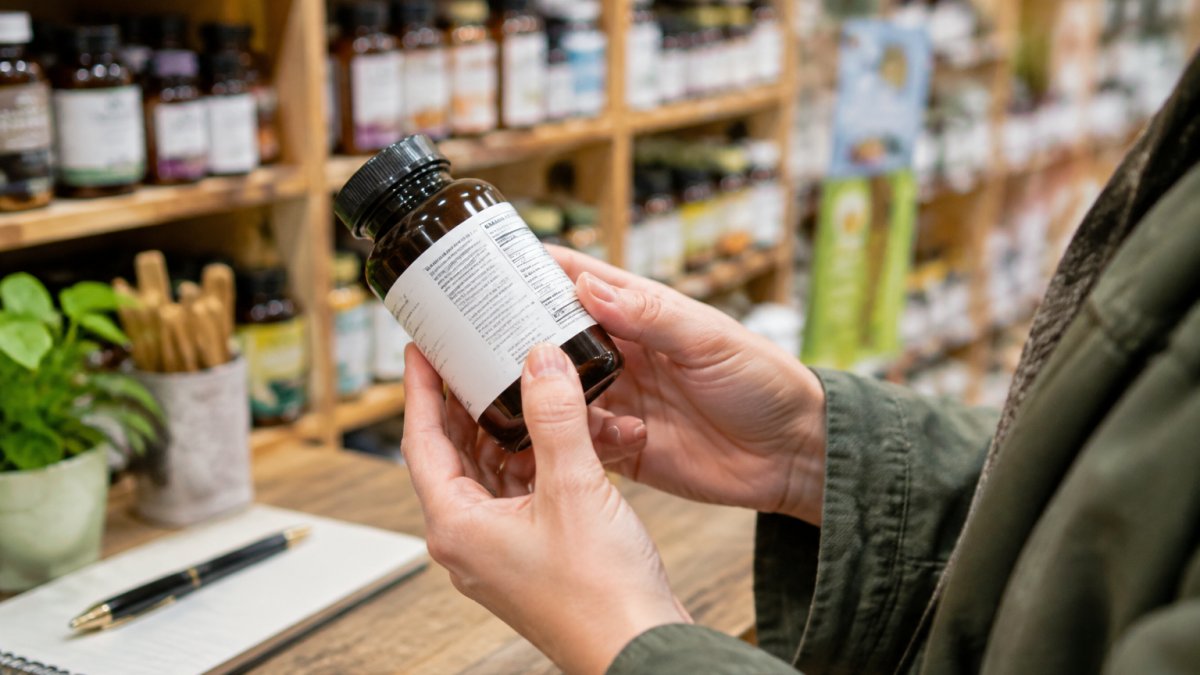
Run this checklist before you reach the till:
- Vegan Society trademark or equivalent certification on the label
- Capsule shell listed as plant cellulose, not gelatin
- No carmine, shellac, or beeswax in the ingredients
- Vitamin D source named as lichen, not lanolin
- Allergen panel checked for your own sensitivities
- Batch and best-before date legible
Watch out: a “suitable for vegetarians” claim is not the same as vegan. Vegetarian capsules often still contain gelatin or shellac.
For a deeper walkthrough on verifying claims, our guide on how to spot fake organic labels covers the checks that separate a real certification from a marketing line.
Vegan Vitamin B12 Supplements: What to Look For in Store
Vegan vitamin B12 supplements should deliver cyanocobalamin or methylcobalamin in a dose you can take daily without fuss. B12 is the one nutrient a plant-based diet does not supply reliably, so this is the bottle worth getting right.
On the shelf, check three things: the form, the strength, and whether it is food-grown. Food-grown B12, cultured into a plant base, suits people who prefer a gentler format. Standard cyanocobalamin is well studied and widely absorbed.
Our pick for most shoppers is NaturesPlus Source of Life Garden Vitamin B-12, a certified organic, food-grown formula with a clear serving size on the label.
Best for: anyone building a daily routine who wants a certified organic option.
Skip if: you need a high-strength therapeutic dose, which is a conversation for your GP.
Vegan Vitamin D Supplements: Lichen and D3 Explained
Vegan vitamin D comes from lichen, a plant source that produces D3 rather than the D2 found in mushrooms. Lichen-derived D3 behaves in the body like the animal-derived version, which makes it the stronger vegan choice.
Look for the source named plainly on the label and paired with a fat base, since vitamin D is fat-soluble. Coconut oil is a common carrier.
A lichen-sourced option worth checking is Together Health, which pairs 1000iu of bioactive vegan D3 with a coconut oil base.
Best for: daily winter support and anyone avoiding lanolin.
Skip if: you have been told by a clinician to take a specific prescription strength.
Vegan Omega-3 Supplements: Algae Oil on the Shelf
Vegan omega-3 supplements use algae oil to supply EPA and DHA directly, skipping the fish entirely. Flax and chia give you ALA, which the body converts poorly, so algae oil is the more direct route.
Check the EPA and DHA figures on the back, not the total oil weight. A bottle listing 500mg of oil may carry far less of the two fatty acids you actually want.
BioCare Vegan Omega 3 is an algae-derived option supplying EPA and DHA for vegetarians and vegans.
Best for: plant-based diets low in oily fish, and anyone watching ALA conversion.
Skip if: you already eat oily fish regularly and get enough from food.
Checking Local Stock Before You Travel
A wasted trip is the most common complaint about buying supplements locally, and almost all of it is avoidable. The fix is a short sequence: locate candidate shops, check their listed stock, then confirm by phone or click-and-collect before you leave. Work through these steps in order.
1. Build a shortlist with a map search. Search using your town or postcode plus the product type, for example “vegan vitamin B12 [town]” or “health food shop near [postcode]”. Use the map pack at the top of the results and open each listing to check opening hours, accessibility, and whether the shop describes itself as a health food shop rather than a general pharmacy. Save three or four candidates rather than one.
2. Use store locators properly. Most multiple pharmacies and larger health chains publish a branch finder. Filter by branch, not by head office, and note the store’s direct phone number rather than the central customer-service line. A branch number reaches someone standing beside the shelf.
3. Check click-and-collect availability. Where a retailer offers click-and-collect, search the exact product and strength on their site and set your local branch as the collection point. If the item shows as collectable today, that is stronger evidence of local stock than a generic ‘in stock online’ badge. If it shows as unavailable for collection, assume the shelf is empty.
4. Phone the branch with specifics. Ask for the exact product name, the form (for example cyanocobalamin rather than methylcobalamin), and the strength in micrograms or iu. Ask them to confirm the item is physically in the shop rather than on order, and ask them to hold it for you if you are travelling any distance. Independent shops usually answer this well because one person knows the shelves; chain stores often cannot confirm without checking the till system.
5. Have a fallback ready. If the first branch cannot confirm, ask whether a nearby branch has it, or whether they can order it in for collection within a stated number of days. A confirmed order date beats an unconfirmed maybe.
Watch out: a website that says ‘in stock’ is describing the warehouse, not the branch. Only a branch-level collection check or a phone confirmation tells you what is actually on the local shelf.
If you are travelling, buy before you go rather than hoping to find the same brand en route. Travel-focused products such as OptiBac Probiotics FOR TRAVELLING ABROAD are worth securing in advance.
Shop in Person or Order Online? A Straight Comparison
Shopping in person wins on advice, label reading and taking one bottle home the same day. Ordering online wins on range and convenience when local shelves come up short.
The trade-off most people miss is that a shop assistant can spot a gelatin capsule in seconds, while a product page buries it three scrolls down.
| Factor | In store | Online |
|---|---|---|
| Advice on suitability | Yes, in person | Limited or none |
| Label inspection | Full bottle in hand | Photos only |
| Range depth | Curated | Very broad |
| Delivery wait | None | Usually a few days |
| Returns | Often simpler | Policy dependent |
For most shoppers, the sensible split is to buy your core daily supplements locally and order the niche items online.
Visit Heather & Rose Health Shop in Watford Town Centre
Heather & Rose Health Shop is an independent natural health store in Watford town centre. We stock a curated range of organic, vegan, gluten-free and sugar-free supplements and skincare, and our team has experience in the natural health industry.
If you have been let down by products that claim to be vegan, bring the label in and ask our team about it.
The hardest part of buying vegan supplements is not finding a shop. It is trusting what is on the label. Heather & Rose Health Shop stocks a curated vegan range, offers bespoke guidance tailored to your dietary needs, and sits in Watford town centre for anyone who wants to check a bottle in person before buying. Get started with Heather & Rose Health Shop and build a supplement routine you can actually trust.
Frequently Asked Questions
Where can I buy vegan supplements in person?
Independent health food shops, pharmacies, supermarkets and specialist vegan stores all carry vegan-friendly lines. Independent health shops tend to stock the widest range of algae-sourced omega-3, lichen vitamin D and B12, and staff can talk you through the label. Pharmacies suit single nutrients and own-brand ranges, while supermarkets are best for a basic multivitamin. Ring ahead to confirm the specific product is on the shelf before making the trip.
How can I check whether a supplement is suitable for vegans?
Look for a registered vegan trademark on the pack, then read the full ingredient list for gelatin, lanolin, magnesium stearate of animal origin, carmine and shellac. Check the capsule shell too: ‘vegetable capsule’ or ‘HPMC’ is fine, ‘gelatin’ is not. If the label is unclear, ask staff for the manufacturer’s specification sheet. A genuine vegan product should be verifiable, not just described as plant-based on the front.
Is it better to buy vegan supplements from a local shop or online?
Local shops let you read the label in your hand, ask questions and take the product home the same day, which suits anyone managing allergies or specific dietary needs. Online wins on range and home delivery when a niche product is not stocked nearby. Many people do both: buy their daily B12 and vitamin D locally and order specialist items online. Check delivery times and returns before ordering.
Can shop staff help me choose a vegan supplement?
Yes, and it is the main reason to visit an independent health shop. Bring a list of anything you already take so they can avoid duplicating nutrients. Ask specifically whether the capsule and coating are vegan, not just the active ingredient.
